The following is from a recent National Defense University [big PDF, download at bottom of post] paper and it is an overview of the strategic quandry that the United States is in;
Measured in blood and treasure, the war in Iraq has achieved the
status of a major war and a major debacle. As of fall 2007, this
conflict has cost the United States over 3,800 dead and over
28,000 wounded. Allied casualties accounted for another 300 dead. Iraqi
civilian deaths—mostly at the hands of other Iraqis—may number as high
as 82,000. Over 7,500 Iraqi soldiers and police officers have also been
killed. Fifteen percent of the Iraqi population has become refugees or
displaced persons. The Congressional Research Service estimates that the
United States now spends over $10 billion per month on the war, and that
the total, direct U.S. costs from March 2003 to July 2007 have exceeded
$450 billion, all of which has been covered by deficit spending.1 No one
as yet has calculated the costs of long-term veterans’ benefits or the total
impact on Service personnel and materiel.The war’s political impact also has been great. Globally, U.S. standing
among friends and allies has fallen.2 Our status as a moral leader has been
damaged by the war, the subsequent occupation of a Muslim nation, and
various issues concerning the treatment of detainees. At the same time,
operations in Iraq have had a negative impact on all other efforts in the war
on terror, which must bow to the priority of Iraq when it comes to manpower,
materiel, and the attention of decisionmakers. Our Armed Forces—
especially the Army and Marine Corps—have been severely strained by
the war in Iraq. Compounding all of these problems, our efforts there
were designed to enhance U.S. national security, but they have become, at
least temporarily, an incubator for terrorism and have emboldened Iran to
expand its influence throughout the Middle East. [emphasis mine]
Friday, April 18, 2008
CHICAGO (Reuters) - Eighteen pork plant workers in Minnesota, at least five in Indiana and one in Nebraska have come down with a mysterious neurological condition they appear to have contracted while removing brains from slaughtered pigs, U.S. researchers and health officials said on Wednesday.
They said the illness is a new disorder that causes a range of symptoms, from inflammation of the spinal cord to mild weakness, fatigue, numbness and tingling in the arms and legs.
"As far as we are aware it is a brand new disorder," said Dr. Daniel Lachance of the Mayo Clinic in Rochester, Minnesota, who presented his findings at the American Academy of Neurology meeting in Chicago.
Lachance has been following the 18 Minnesota patients, all of whom have evidence of nerve involvement, typically affecting the legs.
He said tests showed patients had damage to the nerves at the root level near the spinal cord, and at the far reaches of their motor nerves, where the nerves connect with muscle.
The first cases of the condition were reported in November of last year at Quality Pork Processors Inc in Austin, Minnesota, where workers had been using compressed air to blow pork brains out of the skull cavity.
Thursday, April 17, 2008
Do you think if Barack Obama had left his seriously ill wife after having had multiple affairs, had been a member of the "Keating Five," had had a relationship with a much younger lobbyist that his staff felt the need to try and block, had intervened on behalf of the client of said young lobbyist with a federal agency, had denounced then embraced Jerry Falwell, had denounced then embraced the Bush tax cuts, had confused Shiite with Sunni, had confused Al Qaeda in Iraq with the Mahdi Army, had actively sought the endorsement and appeared on stage with a man who denounced the Catholic Church as a whore, and stated that he knew next to nothing about economics -- do you think it's possible that Obama would have been treated differently by the media than John McCain has been? Possible?
And -- this is fun to contemplate -- if Michelle Obama had been an adulteress, drug addict thief with a penchant for plagiarism -- do you think that she would be subject to slightly different treatment from the media than Cindypills McCain has been? Anyone?
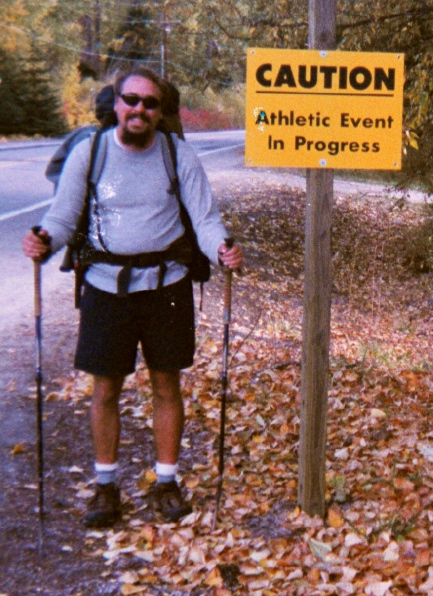
He carry a hundred pound backpack! Definitely not a goliter. His web site.PANAMA CITY (Reuters Life!) - Striding around Panama City on tree-trunk legs that have carried him through 66 countries, 80-year-old U.S. citizen Harry Lee McGinnis reckons he knows the secret of staying healthy into old age.
"Movement," he explains, as he readies for the final stage of an 80,000-mile around-the-world walk that has taken him 18 years so far, inspired by glossy photos of foreign lands he pored over as a child.
A towering figure with a muscular build and the rugged looks of actor Roger Moore, McGinnis is not your average old-age pensioner.
"Moore and I are the same age, but I think he looks older," he jokes.
Wednesday, April 16, 2008

Canada is likely to list bisphenol-a as toxic.
The Canadian government is said to be ready to declare as toxic a chemical widely used in plastics for baby bottles, beverage and food containers as well as linings in food cans.
A person with knowledge of the government’s chemical review program spoke on the condition he not be named because of a confidentiality agreement. He said the staff work to list the compound, called bisphenol-a, or B.P.A., as a toxic chemical was complete and was recently endorsed by a panel of outside scientists.
A public announcement by Health Canada may come as early as Wednesday but could be delayed until the end of May. Canada would be the first country to make a health finding against B.P.A., which has been shown to disrupt the hormonal systems of animals. The department’s decision was first reported in The Globe and Mail, a Toronto newspaper, on Tuesday.
The corporation that makes the stuff already has an it is safe website up.
Potatoes, which are native to Peru, can be grown at almost any elevation or climate: from the barren, frigid slopes of the Andes Mountains to the tropical flatlands of Asia. They require very little water, mature in as little as 50 days, and can yield between two and four times more food per hectare than wheat or rice.
"The shocks to the food supply are very real and that means we could potentially be moving into a reality where there is not enough food to feed the world," said Pamela Anderson, director of the International Potato Center in Lima (CIP), a non-profit scientific group researching the potato family to promote food security.
Like others, she says the potato is part of the solution.
The potato has potential as an antidote to hunger caused by higher food prices, a population that is growing by one billion people each decade, climbing costs for fertilizer and diesel, and more cropland being sown for biofuel production.
The United Nations has declared 2008 as the year of the potato.
Even though the potato emerged in Peru 8,000 years ago near Lake Titicaca, Peruvians eat fewer potatoes than people in Europe: Belarus leads the world in potato consumption, with each inhabitant of the eastern European state devouring an average of 376 pounds (171 kg) a year.
India has told food experts it wants to double potato production in the next five to 10 years. China, a huge rice consumer that historically has suffered devastating famines, has become the world's top potato grower. In Sub-Saharan Africa, the potato is expanding more than any other crop right now.[...]
he potato is already the world's third most-important food crop after wheat and rice. Corn, which is widely planted, is mainly used for animal feed.
Though most Americans associate potatoes with the bland Idaho variety, they actually come in some 5,000 types. Peru is sending thousands of seeds this year to the Doomsday Vault near the Arctic Circle, contributing to a gene bank for food crops that was set up in case of a global disaster.
With colors ranging from alabaster-white to bright yellow and deep purple and countless shapes, textures, and sizes, potatoes offer inventive chefs a chance to create new, eye-catching plates.
Read it all.
The Labor Department reported Tuesday that wholesale prices rose by 1.1 percent last month, the largest increase since a 2.6 percent rise last November. The November gain in the Producer Price Index was the biggest one-month jump in 33 years.Analysts had expected a much more moderate 0.4 percent rise in wholesale prices for the month. However, food costs, which had fallen by 0.5 percent in February, leapt by 1.2 percent last month, propelled upward by big gains in vegetables and beef and the biggest increase in rice prices in more than five years. Those were far higher increases in food prices than expected.
Core inflation, which excludes energy and food, was better behaved last month, rising by just 0.2 percent, down from a worrisome 0.5 percent rise in February.
But with the crude oil price rising to a record close of $113.79 per barrel on Tuesday, analysts said consumers should be braced for more bad inflation news to come.
"Wholesale prices are rising and the consumer should expect more shocks at the supermarket and the gas station," said Joel Naroff, chief economist at Naroff Economic Advisors.
Conservative economics at work.
Tuesday, April 15, 2008
(04-15) 14:13 PDT MARIN HEADLANDS -- The hiker who died Monday after falling over a cliff above Rodeo Beach in the Marin Headlands was identified today as 20-year-old Phoebe Washer, an aspiring artist who grew up in Petaluma.
Washer, who lived most recently in San Francisco with several friends, was hiking with a 22-year-old man along a coastal trail Monday afternoon when he heard her scream and saw rocks falling, authorities said.
Washer plunged down at least a portion of a cliff that was 150 to 200 feet high, said Ozola Cody, a spokeswoman for the Golden Gate National Recreation Area. Her companion, whose name was not released, went down the steep hillside to help Washer, suffering minor injuries in the process.
My condolences to her friends and family.
So much for the liberal media.
John McCain and Barack Obama both appeared before the nation's newspaper editors yesterday. The putative Republican presidential nominee was given a box of doughnuts and a standing ovation. The likely Democratic nominee was likened to a terrorist.
Since the story takes place almost entirely outside, one of the issues with getting A Walk in the Woods off the ground is timing. "We can only shoot at a certain time, because if you don't start at a certain time, you can't do it," he explained. "So it becomes a seasonal issue."
The bigger question is that Robert Redford is attached to play Bryson. And while a story about the challenges a man faces while hiking the Appalachian Trail and dealing with an ornery old friend seems extremely well-suited for Redford, let's just say that's where the similarities between the two -- who have a 15 year age gap between them -- end. "Bryson's older in this movie!" Levinson joked when I asked him about the casting choice. "It's a guy who's a writer, he's married, kids, grandchildren, etc.," he explained. "Most of the country doesn't know Bryson, they know something of his writing. So you had to adapt that aspect of it."
Let's just all cross our fingers and hope the timing works out, because this is one adaptation that we would love to see!
Monday, April 14, 2008
CORN should be used for food, not motor fuel, and yet the United States is committed to a policy that encourages farmers to turn an increasing amount of their crop into ethanol. This may save the nation a bit of the cost of imported oil, but it increases global-warming gases and contributes to higher food prices.Candidates for president need to tell Americans the truth about ethanol, but they are falling over themselves in pursuit of the farm belt vote. Barack Obama and Hillary Clinton want more ethanol factories built than even President Bush envisaged when he called for 15 percent of US gasoline consumption to be replaced by alternative fuels by 2017. John McCain, who correctly called the ethanol push a boondoggle in 2000, now says that it is "a very important way to achieve energy independence."
Ethanol consumes almost a quarter of US corn production. The energy self-sufficiency that all the candidates seek should not come at the expense of the environment or the food supply.
Increased ethanol production isn't the only reason for the spike in food costs, but it's more controllable than drought in Australia, higher fertilizer prices, or increased meat consumption by the Chinese. Unlike those other cost-drivers, ethanol production is encouraged by federal subsidies.
And it's not as though ethanol improves the environment. When emissions inherent in the production process are included, ethanol consumption generates more carbon dioxide per gallon than gasoline, according to a recent report in Science magazine. Conversion of other cultivated biomass, such as sugarcane or soy, presents the same problem. The only biofuel that produces a net benefit is agricultural waste, an uncertain source. The best way for American motorists to use less gasoline is to drive fewer miles in lighter vehicles, rather than rely on the false promise of biofuels.
Read it all. Remember:
Grow corn.
Just for food.
Not cars.
Via Homeless on the High Desert.

Earth quakes are swarming off the Oregon coast. Could it be a sign of a new volcano?
This earthquake “swarm” is unique, according to OSU marine geologist Robert Dziak, because it is occurring within the middle of the Juan de Fuca plate – away from the major, regional tectonic boundaries.
“In the 17 years we’ve been monitoring the ocean through hydrophone recordings, we’ve never seen a swarm of earthquakes in an area such as this,” Dziak said. “We’re not certain what it means. But we hope to have a ship divert to the site and take some water samples that may help us learn more.” The water samples may indicate whether the process causing the earthquakes is tectonic or hydrothermal, he added.
At least three of the earthquakes have been of a magnitude of 5.0 or higher, Dziak said, which also is unusual. On Monday (April 7), the largest event took place, which was a 5.4 quake. Seismic activity has continued through the week and a 5.0 tremor hit on Thursday. Numerous small quakes have continued in between the periodic larger events.
I, of course, have no real knowledge about such things. The picture is really cool though. Here are the rest of the photos.
Our bleakness partly reflects the fact that most Americans are doing considerably worse than the usual economic measures let on. The official unemployment rate may be relatively low — but the percentage of prime-working-age Americans without jobs, which isn’t the same thing, is historically high. Gross domestic product is up, but the inflation-adjusted income of the median family is probably lower than it was in 2000.Beyond that, perceptions of the current economy are strongly influenced by the public’s sense of the larger pattern.[...]
A major reason we’re feeling so down now is that for working Americans the boom never did come back. Job creation in the post-2001 recovery was pathetic by Clinton-era standards; wages barely kept up with inflation. Instead, corporate profits and the incomes of a tiny elite surged — sucking up so much of the economy’s growth that only crumbs were left for everyone else.
Now the boom that wasn’t has gone bust — and Americans, understandably, have lost confidence in the prospects for a return to real prosperity.
They have also, I’d suggest, lost confidence in the integrity of our economic institutions.
Heck, I lost confidence in our economic institutions years ago. It is the deregulation. Good for corporate profits, bad for Americans.
MONTEVIDEO (Reuters) - More than a thousand barbecue fanatics in Uruguay grilled up 12 metric tonnes (26,400 lbs) of beef on Sunday, setting a new Guinness world record while promoting the country's succulent top export.
Army personnel set up a grill nearly 1 mile long and firefighters lit six tonnes of charcoal to kick off the gargantuan cookout.
Some 1,250 people grilled the beef and about 20,000 spectators cried with joy when a Guinness judge confirmed the barbecue record had been broken.
"I'm very proud to be Uruguayan. We have the best beef and now we have the world's biggest barbecue," said one of the volunteer cooks, sporting an apron and chef's hat.
Sunday, April 13, 2008

I am no fan of the Pope but I wish more people would follow his example. Do not eat with these people. Not only Bush, but the whole lot of them, Cheney, Rumsfeld, Powel,Tenet, Feith, Addington, Levin, Yoo, anyone involved in this torture.

Hunters in Wyoming have started to kill wolves. The New York Times has an article about public opinion.
Pro-wolf forces, meanwhile, say that wolf killers may have created a martyr. On the first day protections were lifted, a partly crippled and much photographed radio-collared wolf named 253M was legally shot near the town of Daniel in western Wyoming.
The killing made headlines as far away as Utah, where 253M had wandered in 2002, before being transported back to Wyoming. A story in The Salt Lake Tribune quoted a woman as saying she had wept at the news of the animal’s death.
Responding to what it says are numerous public inquiries, the Wyoming Game and Fish Department began a weekly wolf update on its Web site, starting on April 4.
“We’re hearing a lot, from all sectors of the public,” said a spokesman, Eric Keszler. “Some want no wolves to be killed — others ask where the trophy game area is going to be.”
Wyoming, Montana and Idaho plan their first wolf trophy hunting seasons this fall. About 1,500 wolves inhabit the three states, most of them descended from 66 wolves introduced into Yellowstone National Park and central Idaho in the mid-1990s.
State management plans allow for wolf hunting — or in some places, outright eradication — with a target population of 150 in each of the three states.
Saturday, April 12, 2008

I find it hilarious that it took the store ten hours to figure it out and fix it. A direct result of the corporatization of the convenience stores I'd guess. It's rare to find a privately owned one anymore. They join conglomerates in order to survive in a 'free market' that favors corporate buying power.Whoever made the mistake was probably a close to minimum wage employee and it took a long time to fix because the store had to get permission from the regional manager to change the price. One expects that's because there is some kind of blocking system that prevents them from changing it more than once a day to prevent inside theft. In any event, one of the clerks is blaming the public for the long duration of the mistaken price.
“People had been coming in all day stiffing us, not telling us nothing,” Weller said. “They knew something was wrong because regular gas was still $3-something a gallon, and when have you ever known premium gas to be lower than regular?”
You might also have thought that the clerks would notice a lot of people suddenly buying ten bucks worth of gas instead of thirty or more when it still took just as long to fill up but leaving that aside, what would do if you suddenly discovered 35 cent gas? Would you tell the clerk or tell your friends?
I would like to add that gas was last 35 cents in 1972.
The Pacific Fishery Management Council voted Thursday to ban commercial and recreational fishing of chinook salmon off the California coast and most of Oregon this year to reverse an unprecedented decline in the Sacramento River, traditionally one of the West Coast's most productive wild salmon runs.
The council also recommended that sport and commercial fishing be sharply curtailed off the Washington coast to protect depressed salmon stocks there.
The National Marine Fisheries Service, part of the U.S. Department of Commerce, is expected to approve the council's recommendations by May 1, the start of the commercial season.
"It's going to be extremely tough because for a lot of fishermen salmon is at least 50 percent of their income," said Zeke Grader, who heads the Pacific Coast Federation of Fishermen's Associations. "We need to figure out how to cushion this so people can stay afloat."
Most of the articles refuse to say what caused it. Scientists say it is unknown. We made the water a garbage dump.
There seems to be no great mystery about the collapse of the salmon fishery. "Salmon are trapped between human population growth, economic development, degradation of environmental quality and the politics of public policy," Montgomery wrote. There are a lot of reasons the population of salmon returning to their spawning grounds on the Sacramento River and its tributaries dropped from 800,000 six years ago to 68,000 last year. Some say the food chain in the ocean has changed; some say global warming has made the ocean too warm for the fish, and you can find fishermen who think the fishery has been mismanaged. Maybe it was overfishing. Maybe, as Fitzpatrick thinks, the fry from fish hatcheries were dumped in the bay from pipes, and, stunned, were eaten by predators. Then there are the dams. Over the last 60 or 70 years, California has diverted most of the flow of its water from the Central Valley to farms and Southern California. The rivers that drain the Sierra used to flow through the valleys and into the ocean; millions and millions of gallons poured through the Golden Gate. First Shasta Dam diverted water from the Sacramento; then the Friant Dam was built to take water from the San Joaquin River. All these rivers and their tributaries were prime salmon runs. "You know there was a million fish run on the San Joaquin River before the water was diverted?" says Collins. "You know that at Los Banos, they caught 800,000 fish?" Los Banos is near what is now Interstate 5. The San Joaquin River near there is now almost dry; no fish could survive in it. Then the state built the California Water Project, diverting the flows of the Sacramento and Feather rivers. One result was the collapse of the delta smelt, a small fish that is thought to be the bellwether of the health of the Sacramento-San Joaquin River Delta. All the salmon, returning to spawn or swimming downstream to the ocean, must pass through the delta. "The delta," said Collins, "is just a sewer now." "Without water, the fish can't live," he said. "We sacrificed the fish for farms and to water lawns." It really is sad.
Friday, April 11, 2008
Breaking News: Plight Of Missing Hikers Will Make Great Movie
Mr. Wood lost his truck last month when he could no longer afford the payments due to the spike in diesel prices. Now he's back to driving for a company.
"In six months, everybody operating on a shoestring will be gone," says Campbell, celebrating his birthday with a senior egg breakfast. "If I had a truck payment, I'd be hurting."
While all Americans are facing sticker shock at the pump these days, truckers have been hit particularly hard, watching the cost of diesel skyrocket past gasoline. The national average for diesel is hovering just above $4 a gallon, due to high crude-oil prices and rising demand for diesel, especially in China and Europe. Truckers often pay close to $1,000 to fill up a tank that might have cost $600 to fill a few years ago.
Independent truckers – those, like Campbell, who own their own rigs – are the ones being hit the hardest. They make up roughly a third of truckers. With little pricing power or ability to collect fuel surcharges, many of them are accepting hauls that barely allow them to break even or that even lose money. Conditions are bad enough that a week ago, some truckers tried scattered protest attempts – strikes, slow drives to tie up traffic, or drives to state capitols – which largely fizzled due to the unorganized nature of the industry.
Everything in this country gets on a truck sometime. It raises the price of everything.
Some readers may already have recognized the story of Trina Bachtel. While campaigning in Ohio, Hillary Clinton was told this story, and she took to repeating it, without naming the victim, on the campaign trail. She used it as an illustration of what’s wrong with American health care and why we need universal coverage.
Then The Washington Post identified Ms. Bachtel, the hospital where she died claimed that the story was false — and the news media went to town, accusing Mrs. Clinton of making stuff up. Instead of being a story about health care, it became a story about the candidate’s supposed problems with the truth.
In fact, Mrs. Clinton was accurately repeating the story as it was told to her — and it turns out that while some of the details were slightly off, the essentials of her story were correct. After all the fuss, The Washington Post eventually conceded that “Bachtel’s medical tragedy began with circumstances very close to the essence” of Mrs. Clinton’s account.
And even more important, Mrs. Clinton was making a valid point about the state of health care in this country.
The media hates the Clintons. If Obama gets the nomination he will get the same treatment.
Thursday, April 10, 2008
But, by and large, the farm bill song remains the same: Commodity agribusiness gets the lion's share; reformers get table scraps. Absent a more vocal public outcry, the agribusiness lobby, which spent $80 million in 2007, again holds the winning hand.
What can we citizens expect if the proposed $300-billion farm bill is signed into law? Federally subsidized feed -- corn, soybeans and cottonseed -- for animal factory farms that spread disease, greenhouse gases and dangerous working conditions wherever they set up shop. (Farm bill "environmental quality" programs will even pay up to $450,000 for the construction of lined "lagoons" to be filled with lethal concentrations of manure.) The continuation of America's obesity campaign, which ensures the cheapest and most widely available foods are made up of such high-calorie ingredients as high-fructose corn syrup, refined flours, saturated fats and unhealthy meat and dairy products. And more federally backed exports of California's water -- in the form of cotton and rice, mostly sold overseas.
But here's the one that's really hard to stomach. More than $4 billion in permanent disaster assistance to growers in the Northern Plains. The brainchild of Montana Democrat and Senate Finance Committee Chairman Max Baucus, this is essentially a trust fund to guarantee income to farmers plowing up prairies and grasslands -- lands prone to drought and erosion -- to plant corn and wheat. Many observers fear a second Dust Bowl.
We must stop the insanity. Click on the fix the farm bill button upper right to see how.
It has some great beer quotes too.
"I am a firm believer in the people. If given the truth, they can be depended upon to meet any national crisis. The great point is to bring them the real facts, and beer." -- Abraham Lincoln
"Not all chemicals are bad. Without chemicals such as hydrogen and oxygen, for example, there would be no way to make water, a vital ingredient in beer." -- Dave Barry
I am reminded of a great quote from Frogman, who worked at Samuel Adams. Frogman said Sam Adams unofficial motto was " You can not drink all day, unless you start in the morning."
Describing the Bush administration’s affinity for torture, Michael Stickings noted this morning, “[I]t’s not all about John Yoo. The U.S. didn’t just start torturing its detainees because a government lawyer said it was okay, or because some executive-branch extremist like David Addington determined that anything and everything was permissible in a time of war, or because some dim-witted troops at Abu Ghraib just didn’t know any better. At some point, early on, a decision to allow torture, to enable it, must have been made — and it must have been made at the highest levels of government.”
In dozens of top-secret talks and meetings in the White House, the most senior Bush administration officials discussed and approved specific details of how high-value al Qaeda suspects would be interrogated by the Central Intelligence Agency, sources tell ABC News.
The so-called Principals who participated in the meetings also approved the use of “combined” interrogation techniques — using different techniques during interrogations, instead of using one method at a time — on terrorist suspects who proved difficult to break, sources said.
Highly placed sources said a handful of top advisers signed off on how the CIA would interrogate top al Qaeda suspects — whether they would be slapped, pushed, deprived of sleep or subjected to simulated drowning, called waterboarding.
The high-level discussions about these “enhanced interrogation techniques” were so detailed, these sources said, some of the interrogation sessions were almost choreographed — down to the number of times CIA agents could use a specific tactic.
The “Principals,” ABC reported, included Vice President Dick Cheney, Defense Secretary Donald Rumsfeld, Secretary of State Colin Powell, CIA Director George Tenet, Attorney General John Ashcroft, and National Security Advisor Condoleezza Rice, who chaired the meetings.
According to one top official, Ashcroft reportedly asked aloud after one meeting, “Why are we talking about this in the White House? History will not judge this kindly.
Impeach the mother all ready.
The 15-metre (50-foot) long ship, named after the Norse god Thor, is made from 15 million recycled ice-cream sticks glued together by U.S.-born stuntman Robert McDonald, his son and more than 5,000 children.
"If you can dream it you can do it ... I want to teach children that anything is possible," McDonald said
Wednesday, April 09, 2008
Petraeus and Crocker repeatedly quoted Osama Bin Laden and his deputies that Iraq was the central fron in the war on terror. But as Senators Bayh and Feingold pointed out we shouldn't take our marching orders from Al Qaeda, as their strategy is to bleed and bankrupt the United States in Iraq.[...]
Petraeus and Crocker repeatedly quoted Osama Bin Laden and his deputies that Iraq was the central fron in the war on terror. But as Senators Bayh and Feingold pointed out we shouldn't take our marching orders from Al Qaeda, as their strategy is to bleed and bankrupt the United States in Iraq.
Read it all. There is no reason to stay in Iraq.
Better barley breeds could be the salvation for the beer brewing industry as global warming threatens crop production, an industry conference has heard.
Industry scientists and brewers from more than 24 countries in Auckland for the Institute of Brewing and Distilling's convention heard yesterday that climate modelling pointed to an increased drying in barley growing areas in New Zealand and Australia.
Jim Salinger, principal scientist with the National Institute of Water and Atmospheric Research, told the conference that Canterbury, the main barley growing area in New Zealand, would likely be adversely affected as it gets hotter and drier.
We need to start working on solutions to the looming water crisis.
Water is going to be such an issue of global concern that any water wastage is going to be seen as unacceptable," he told the conference.
Tuesday, April 08, 2008
At 12:01 a.m. on April 7, 1933, sirens, fire alarms and train whistles shrieked. In Chicago, harried bartenders scrambled to serve crowds that stood 12 deep. At Pabst Brewing Co. in Milwaukee, thousands of onlookers cheered as company employees hoisted barrels and crates onto trucks. About 800 people stood in the rain outside the White House, watching as a man hopped out of his vehicle and unloaded two cases of beer. Secret Service agents accepted the goods, a gift for the chief executive from one of the nation's brewers. "President Roosevelt," read a sign on the side of the truck, "the first real beer is yours."
After 13 dry years, legal beer had returned to the United States. It may seem silly to commemorate that day's 75th anniversary. After all, it's only beer, and we've got bigger things to think about. War. Global warming. Soaring gas prices. Crashing home prices. But that's all the more reason to celebrate. We could use a reminder of the way action inspires hope, and hope inspires action.
In early 1933, the height of the Depression, nearly 25% of adults in this country were out of work. Foreclosure and bankruptcy plagued every community. A cascade of bank failures had destroyed the savings of millions of people. Children skipped school for lack of clothes and shoes. Men and women stood in soup lines, and the homeless and jobless marched in angry protests.
On March 4, President Franklin D. Roosevelt was inaugurated. He had campaigned on the promise of a "new deal" to repair the economy, a vague plan that was short on specifics but long on ambition. But he had also made one definite pledge: to repeal Prohibition.
Today, we look back on Prohibition as an exercise in temporary insanity, but the 13-year experiment in sobriety was rooted in our quintessentially American faith that we can perfect the world. A broad cross section of people -- men and women, urban and rural, young and old -- supported the ban on alcohol because they believed that it would reduce crime, alleviate poverty, strengthen the family and nurture a more perfect union.
Please read it all. But there are other things that are being prohibited today that are increasing crime. If legal would decrease crime and help us get out of this depression.
It was the maps.“By the end of the first day, I had this massively profound and deep feeling of ‘I don’t want to carry this thing for any reason,’” he says. “127 pounds turned out to be too much.” Umm, yea.
His original goal was to hike until April 30th and break the current 620-mile World Alpine Style Backpacking Distance record. “I have maps for about 1100 miles,” he said before he left. “And it’d be a shame to carry a bunch of maps many hundreds of miles and then not use them.” He made it 31 miles. But, he did set a new record, after all. From Mountain Crossing, Coup mailed home 115 pounds of stuff, blowing their average 12 pound ship-off out of the water. Then, he continued traipsing about for a few more says with a less-than-30-pound load before calling it quits altogether.
World alpine style backpacking distance record.
Here are the number of times, according to NEXIS, that various topics have been mentioned in the media over the past thirty days:
"Yoo and torture" - 102"Mukasey and 9/11" -- 73
"Yoo and Fourth Amendment" -- 16
"Obama and bowling" -- 1,043
"Obama and Wright" -- More than 3,000 (too many to be counted)
"Obama and patriotism" - 1,607
"Clinton and Lewinsky" -- 1,079
And as Eric Boehlert documents, even Iraq -- that little five-year U.S. occupation with no end in sight -- has been virtually written out of the media narrative in favor of mindless, stupid, vapid chatter of the type referenced above. "The Clintons are Rich!!!!" will undoubtedly soon be at the top of this heap within a matter of a day or two.
Here is what the Yoo memo is about. Scott Horton
The exact circumstances surrounding the dealings between Haynes and Yoo that led to the development of this memorandum are unclear. However, it is clear that Haynes had previously authorized the use of the torture techniques, and had secured an order from Secretary of Defense Rumsfeld authorizing them.
Following the implementation of these techniques, more than 108 detainees died in detention. In a large number of these cases, the deaths have been ruled a homicide and connected to torture. These homicides were a forseeable consequence of the advice that Haynes and Yoo gave.
The government orders the torture and deaths of 108 people. This is certainly more important than Obama's bowling ability. The media will never talk bad about a republican.
Where the effects of bad policy are clearest, however, is in the rise of demon ethanol and other biofuels.
The subsidized conversion of crops into fuel was supposed to promote energy independence and help limit global warming. But this promise was, as Time magazine bluntly put it, a “scam.”
This is especially true of corn ethanol: even on optimistic estimates, producing a gallon of ethanol from corn uses most of the energy the gallon contains. But it turns out that even seemingly “good” biofuel policies, like Brazil’s use of ethanol from sugar cane, accelerate the pace of climate change by promoting deforestation.
And meanwhile, land used to grow biofuel feedstock is land not available to grow food, so subsidies to biofuels are a major factor in the food crisis. You might put it this way: people are starving in Africa so that American politicians can court votes in farm states.
Oh, and in case you’re wondering: all the remaining presidential contenders are terrible on this issue.
Read it all.
Monday, April 07, 2008
And some wonder why campaign reporters are referred to as McCain’s “base.” Acosta was reading a script that might as well have been written by the senator’s own aides, except they may have been more even-handed for fear of embarrassment.
Digby added:First of all, the question was perfectly legitimate, not a heckle at all. Second McCain tries to claim it isn’t political, which is completely absurd since he’s the presumptive Republican nominee for president of the United States. And then this bozo compares this perfectly reasonable question to McCain taking incoming fire!
Is there really no occasion where the McCain’s Hannah Montana fanboys don’t find it necessary to mention his mighty warrior mien? Even questions from high schoolers?
I can’t take another four years of codpiece worship. I just can’t.
I’ll admit that I don’t get a lot of exposure to television news, but in 2004, I’m fairly certain John Kerry took plenty of challenging questions from various audiences. Did CNN ever tell viewers, “John Kerry, who is no stranger to incoming fire, was able to handle that heckler there”? I doubt it.
Call it a hunch.
Americans may fret that Wheat Thins cost 15 percent more than a year ago but in poor nations, such price hikes aren't taken lightly. In Ivory Coast last week, women rioted against higher food costs, leaving one person dead.
In Haiti, four people were killed in protests last week over a 50 percent rise in the cost of food staples in the past year. From Egypt to Vietnam, price rises of 40 percent or more for rice, wheat, and corn are stirring unrest and forcing governments to take drastic steps, such as blocking grain exports and arresting farmers who hoard surpluses.[...]
Even in grain-rich America, wholesale food prices are rising at a rate not seen in 27 years. The most acute "ag-flation," however, is in Asia and Africa, where food costs take up a higher proportion of family income. And the face of hunger is now seen more in cities as a historic shift takes place with more than half of the world's population soon to be living in or near urban areas.
Notice the term ag-flation. Food and fuel are not included in the inflation calculus. It is a good thing too otherwise inflation would be sky rocketing. This allows the talking heads on the TV to say inflation is not bad. When of course it is.

A grant to complete a section of the Appalachian Trail in Vermont has been given.
WATERBURY CENTER — The Green Mountain Club has received a $15,000 Quality of Life grant from the Christopher and Dana Reeve Foundation.
The award was one of almost 100 grants totaling almost $800,000 awarded by the Reeve Foundation to nonprofit organizations that help people living with disabilities become more fully integrated members of society.
The GMC will use the grant to complete construction of a wheelchair-accessible boardwalk, graded packed-stone pathway and elevated-viewing platform providing access to the base of Thundering Falls, one of the tallest waterfalls in Vermont.
The new trail is a relocation of a portion of the Appalachian Trail in Killington. Previously, the trail was located along a half mile of road. Now it is a scenic boardwalk, including a short spur trail to the foot of the falls, which can be enjoyed by a wider spectrum of visitors.
According to Ben Rose, GMC executive director, "Maintaining Vermont's hundreds of miles of rugged hiking trails is a huge annual undertaking. The Thundering Falls relocation presented an opportunity to do something special and unique on the Appalachian Trail in Northern New England. Because the Ottauquechee River's floodplain is flat, this stretch of trail is unlike most of the Appalachian Trail in Vermont."
It will be a much better section of trail than the road walk that is there now. Plus it goes by a waterfall. The reroute has been going on for years. There are more photos here from flicker user Kezee. It looks like she has worked on the reroute over the years. Thanks Kezee!
Sunday, April 06, 2008
In Iraq, the groundwork has been laid to protect the patents of Monsanto and other G.M.-seed companies. One of L. Paul Bremer’s last acts as head of the Coalition Provisional Authority was an order stipulating that “farmers shall be prohibited from re-using seeds of protected varieties.” Monsanto has said that it has no interest in doing business in Iraq, but should the company change its mind, the American-style law is in place.
To be sure, more and more agricultural corporations and individual farmers are using Monsanto’s G.M. seeds. As recently as 1980, no genetically modified crops were grown in the U.S. In 2007, the total was 142 million acres planted. Worldwide, the figure was 282 million acres. Many farmers believe that G.M. seeds increase crop yields and save money. Another reason for their attraction is convenience. By using Roundup Ready soybean seeds, a farmer can spend less time tending to his fields. With Monsanto seeds, a farmer plants his crop, then treats it later with Roundup to kill weeds. That takes the place of labor-intensive weed control and plowing.
Monsanto portrays its move into G.M. seeds as a giant leap for mankind. But out in the American countryside, Monsanto’s no-holds-barred tactics have made it feared and loathed. Like it or not, farmers say, they have fewer and fewer choices in buying seeds.
And controlling the seeds is not some abstraction. Whoever provides the world’s seeds controls the world’s food supply.
Read it all. They are not nice.
Saturday, April 05, 2008
UPDATE: One other point to note about all of this is that these fixations are as skewed as they are vapid. Barack Obama is an exotic elitist freak because he went to Harvard Law School and made $1 million from his book. Hillary Clinton can't possibly have any connection to the Regular Folk because her husband, who grew up dirt poor, became quite wealthy after being President. John Kerry was completely removed from the concerns of the Regular People because his second wife was rich.By contrast, George W. Bush was a down-home, salt-of-the-earth Man of the People despite being the grandson of a U.S. Senator, the son of a President (who greatly magnified his riches in his post-presidency), and the by-product of an extremely wealthy, coddled life. Ronald Reagan was pure Americana despite spending most of his adult life as a very wealthy Hollywood actor (and converting his post-presidency into far greater riches still). And John McCain is as Regular a Guy as it gets, even though he dumped his first wife (the mother of his three children) after she was disfigured and disabled by a near-fatal car accident so that he could marry his much younger, much prettier, and extremely wealthy heiress-mistress, whose family riches then launched his political career and sustained a life of luxury for almost three decades (that's how "McCain's Sedona ranch" -- i.e., his compound -- came to be).
It would be bad enough if our political press were obsessed with such trivialities. The fact that they do so in such a Republican-leader-worshiping manner makes it only that much worse, particularly given that it's this dynamic, more than anything else, that determines the outcome of our elections.

I think we need to see more urban farming people need to be close to their food. It is good for the heart and soul. I found this post from Jennie Love at Eat. Drink. Better.
So what is an urban farm? Since they’re often the size of large gardens due to land constraints within city limits, let’s first define the difference between a “farm” and a “garden”. According to Webster, a farm is “a tract of land…on which crops and often livestock are raised for livelihood.” A garden, on the other hand, is “a plot of ground…where flowers, shrubs, vegetables, fruits, or herbs are cultivated.” While one is a tract and the other a plot, the real difference between a farm and a garden is the expectation of turning a profit from the produce being grown. Thus, an urban farm can be loosely defined as an agricultural pursuit taking place within the boundaries of a city with the intent to sell what it harvests.
Still thinking the idea of a farm in the middle of the city is a little odd? While it has required some unconventional/creative methods, farming in the city really isn’t that unusual. Urban agriculture has been used by the United Nations in many developing countries to encourage a healthy food chain and to generate jobs in the poorest cities of the world. Conversely, a few enterprising Canadians started farming their backyard and their neighbors’ backyards two decades ago with the mission of reconnecting North Americans to sustainable farming methods. As a direct result of their labors, new methods for intensive planting and harvesting in order to generate much greater yields from small plots of land (called “SPIN” farming) have been developed to make farming in the city not just possible, but quite often profitable.
Read it all.
The one gold-digging law that hasn’t changed over the years is this: If you want to make money during a gold rush, don’t mine the hills. Mine the miners.
The New 49ers Prospecting Club, in Happy Camp, Calif., charges members $2,500 each for lifetime access to claims on several rivers and tributaries in northernmost California. Dave McCracken, the club’s owner, says he expects gold-prospecting to bring about $5 million this summer into Siskiyou County, an economically depressed region.
Jerry Keene, 73, the chief executive of Keene Engineering, a leading manufacturer of mining equipment, said, “Anything connected with gold, we’re just about out of.”
The one gold-digging law that hasn’t changed over the years is this: If you want to make money during a gold rush, don’t mine the hills. Mine the miners.
The New 49ers Prospecting Club, in Happy Camp, Calif., charges members $2,500 each for lifetime access to claims on several rivers and tributaries in northernmost California. Dave McCracken, the club’s owner, says he expects gold-prospecting to bring about $5 million this summer into Siskiyou County, an economically depressed region.
Jerry Keene, 73, the chief executive of Keene Engineering, a leading manufacturer of mining equipment, said, “Anything connected with gold, we’re just about out of.”
Friday, April 04, 2008
GREEN VALLEY LAKE -- The body of Dean Christy, a North Hollywood man who went hiking in the Green Valley Lake area in early January and never returned, was found this morning by members of the Rim of the World Search & Rescue Team, according to the San Bernardino County Sheriff's Department.The body of an adult male -- later identified by coroner's investigators as Christy -- was found in a remote mountain valley at about 11:30 a.m. during a weekly search.
Rim of the World Search & Rescue Team members Jim Morrell, Fred Palmer and Duane Steiner had been searching different areas in and around Green Valley Lake the past five Fridays in the hope of finding Christy, 62, who was reported lost on Jan. 4.
My condolences to his friends and family.

Friday bird feeder blogging, with new features. Yesterday, I saw this birding post by Ruth and thought, I should add cool facts too.
- Population density and range of the Northern Cardinal has increased over the last 200 years, largely as a response to habitat changes made by people. However, it is listed as a species of special concern in California and may disappear there because of habitat loss.
- The female Northern Cardinal sings, often from the nest. The song may give the male information about when to bring food to the nest. A mated pair shares song phrases, but the female may sing a longer and slightly more complex song than the male.
- The male cardinal fiercely defends its breeding territory from other males. When a male sees its reflection in glass surfaces, it frequently will spend hours fighting the imaginary intruder.
- Brighter red males hold territories with denser vegetation, feed at higher rates, and have greater reproductive success than duller males.
Elizabeth Edwards has cancer. John McCain has had cancer in the past. Last weekend, Mrs. Edwards bluntly pointed out that neither of them would be able to get insurance under Mr. McCain’s health care plan.It’s about time someone said that and, more generally, made the case that Mr. McCain’s approach to health care is based on voodoo economics — not the supply-side voodoo that claims that cutting taxes increases revenues (though Mr. McCain says that, too), but the equally foolish claim, refuted by all available evidence, that the magic of the marketplace can produce cheap health care for everyone.
As Mrs. Edwards pointed out, the McCain health plan would do nothing to prevent insurance companies from denying coverage to those, like her and Mr. McCain, who have pre-existing medical conditions.
The McCain campaign’s response was condescending and dismissive — a statement that Mrs. Edwards doesn’t understand the comprehensive nature of the senator’s approach, which would harness “the power of competition to produce greater coverage for Americans,” reducing costs so that even people with pre-existing conditions could afford care.
This is nonsense on multiple levels.
Read it all.
At Port Clinton, many hikers conduct a resupply, take in a meal at the Port Clinton Hotel, catch a ride down to Cabela’s Outdoor Outfitter or pick up mail and packages forwarded to the Port Clinton Post Office.
If the hikers are lucky, they contact Scott Russell, owner of “Ye Olde Backpacker” near Orwigsburg. You may not have heard of “Ye Olde Backpacker,” but thankfully, many through-hikers are well acquainted with this business and the communities of Orwigsburg and Pottsville.
“Ye Olde Backpacker” offers a unique service for the A-T hikers, providing supplies, opportunity for rest and even a shuttle service. According to Scott, many hikers visit the Yuengling Brewery, while others shop for groceries in Orwigsburg and eat at local restaurants. One group of hikers used Scott’s shuttle and spent a day at Knoebels Amusement Resort, Elysburg.
In 2007, more than 300 hikers, representing 42 different states and seven countries, passed through “Ye Olde Backpacker.” More than 200 visited the Yuengling Brewery in Pottsville, and 82 of them stayed at local hotels and motels. More than 300 shopped in Orwigsburg and ate two meals in the area. With the Appalachian Trail here in our own front yard, we often overlook the impact that our outdoor recreation provides for our own benefit. But in that same line of thinking, have you ever considered the positive impact that the Appalachian Trail has had on our business community?
Thursday, April 03, 2008
SHAWNEE NATIONAL FOREST - The U.S. Forest Service is enforcing the 10-person limit rule in the Lusk Creek, Garden of the Gods and Bay Creek Wilderness areas.I just spent a lot of time on the Shawnee National Forest website and can find no mention of the 10 or more rule. I assume Mr. O'Dell made an enemy at the park service some how. It seems fishy to me. Here is what Park Spokesperson Becky Banker has to say.
On Friday, the Forest Service issued a citation to John O'Dell, chairman of the River to River Trail Society and chairman of Saline County Tourism Board, charging he was in violation of the law that went into effect last year.
“To the best of my knowledge, he is the only one so far,” Shawnee National Forest spokeswoman Becky Banker said.
O'Dell said the evidence used by the Forest Service was a group photograph on an Internet site indicating the hike was Nov. 3, 2007, in the Lusk Creek Wilderness Area. There are 27 people in the photograph, and the photographer made 28 people in the group on that day. The hike was one of the scheduled Saturday morning hikes of the River to River Trail Society.
O'Dell said the fine was $375 and he was told if he contests the citation in court, the judge could sentence him to $5,000 or six months' imprisonment.
Banker said she is not aware whether the trailheads for the wilderness areas have postings up making people aware of the 10-person group limit.
“I can't tell you it is posted today, but since we have enforced the rule, we have had it posted,” Banker said.
She said the agency's notices on bulletin boards are constantly being torn down.
“We have had press releases, notices here at the office and on the Web site,” Banker said.
Banker said every person that is in a group is considered responsible for the size of the group and is subject to a citation. She did not know if every person in the photograph of the Nov. 3, 2007, should expect a citation.
“The only thing I'm getting in response to that is the situation is under investigation,” Banker said.
The Trail Designation Project's group size limit rule indicates if separate groups come together in one of the three Wilderness Areas and there are more than 10 in the same area they are to separate immediately or risk a citation. Trailheads and horse tie-up areas are exempted.
I have looked on the website and can not find the 10 person limit. Can You?
Update: In comments Lisa From the Forest Service left a link to the pdf that explains the group limitations. I could not find it. So to find it without forest service help. Go to the front page Of the Shawnee National Forest website. Click on current conditions. Click on List of forest orders. Click on Group size limitations. Then download the pdf and open it to read it.

Created by OnePlusYou
Via Tengrain's wonderful blog Mock, Paper, Scissors.

What a beautiful animal. With wolf populations on the rise there are groups that want to start hunting them. From the Christian Science Monitor.
'
Wolves were hunted and killed with more passion than any other animal in US history," according to the US Fish and Wildlife Service. As the gray wolf makes a comeback, so does that passion, and with it the need to balance human life with wildlife.
Wolves – predators that play a critical role in the food chain – used to roam widely in America's contiguous states. An estimated 350,000 of them preyed on deer, elk, bison and other animals before the time of Lewis and Clark. But as wolves turned more to livestock, ranchers hit back. By the 1930s, the US government had helped eradicate wolves from more than 95 percent of their former range.
But after receiving protection under the Endangered Species Act in 1973, gray wolves pawed their way back – this time through the help of a US recovery plan. They're still in trouble in the Southwest. But recently, they were removed from the endangered species list in the western Great Lakes region when they reached a population of 4,000. Last week, they were delisted in three Rocky Mountain states, where they number about 1,500 on mostly federal lands.
But the Rocky Mountain delisting gravely worries many environmentalists. They fear "hostile" laws in Idaho, Montana, and Wyoming – where ranchers are not happy with the wolf resurgence. Those laws allow killing that could whittle down the canid population to its federally set minimum of 300 for the region.
Wednesday, April 02, 2008
Higher food costs, they say, could push pasture-raised milk and meat past its boutique status, make organic food more accessible and spark a national conversation about why inexpensive food is not really such a bargain after all.
“It’s very hard to argue for higher food prices because you are ceding popular high ground to McDonald’s when you do that,” said Mr. Pollan, a contributor to The New York Times Magazine and author of “In Defense of Food: An Eater’s Manifesto” (Penguin Press). “But higher food prices level the playing field for sustainable food that doesn’t rely on fossil fuels.”
The food-should-cost-more cadre wants to change an agricultural system that spends billions of dollars in government subsidies to grow commodities like grain, sugar, corn and animal protein as cheaply as possible.
The current system, they argue, is almost completely reliant on petroleum for fertilizers and global transportation. It has led to consolidations of farms, environmentally unsound monoculture and, at the end of the line, a surplus of inexpensive food with questionable nutritional value. Organic products are not subsidized, which is one reason those products are more expensive.
As a result, the theory goes, small farmers can’t make a living, obesity and diabetes are worsening, workers are being exploited and soil and waterways are being damaged. In other words, the true cost of a hamburger or a box of macaroni and cheese may be a lot more than the price.
Tuesday, April 01, 2008
Under current federal policy, farmers receive “direct payments” each year, no matter what crops they grow or how they grow them. A multifunctional approach would build on and rechannel those payments, along with other crop-support subsidies, toward sustainable social and conservation goals. “Instead of tying payments to crops and yields, we should tie them to the services that farmers provide for the public.” In the past, “public services” has meant cheap food at the supermarket, but Dobbs believes it is time to rethink the whole idea. “Pay farmers to reduce synthetic fertilizers and pesticides. Pay them to enhance wildlife, diversify their crops, build soil, and restore wetlands. Pay them to develop local markets for their products, especially fresh food.”
Dobbs is skeptical about the ethanol boom. “I just don’t think it is an economically viable approach to our energy problems.” And he is suspicious as well of the long-term impact of converting thousands of acres of marginal land to the production of energy crops. “We may end up undoing decades of good conservation work if farmers are encouraged to take land out of uses that enhance conservation and put it into ethanol crops.” But in theory, he believes that using farms to support wind, solar, and other alternative-energy programs is well within the framework of multifunctionality. Those are the carrots.
He is also prepared to use a stick. “If farmers want to plow native prairie, they should not be in the program. If they want to grow single-crop monocultures without rotation and play the commodity market, that’s their right, but the government should not pay for it. If they pollute, charge them to clean it up. Don’t use public money to pay large hog-confinement operations to build expensive waste ponds. That should be part of the cost of doing business.”
The tenets of multifunctionality are already at work in Europe. The United Kingdom has folded the services of its old agriculture ministry into a new Department of the Environment, Food, and Rural Affairs. But don’t expect a breakthrough soon in the United States.
It is a good article.
Dismal projections by the Congressional Budget Office in Washington suggest that in the fiscal year starting in October, 28 million people in the US will be using government food stamps to buy essential groceries, the highest level since the food assistance programme was introduced in the 1960s.
The increase – from 26.5 million in 2007 – is due partly to recent efforts to increase public awareness of the programme and also a switch from paper coupons to electronic debit cards. But above all it is the pressures being exerted on ordinary Americans by an economy that is suddenly beset by troubles. Housing foreclosures, accelerating jobs losses and fast-rising prices all add to the squeeze.
Emblematic of the downturn until now has been the parades of houses seized in foreclosure all across the country, and myriad families separated from their homes. But now the crisis is starting to hit the country in its gut. Getting food on the table is a challenge many Americans are finding harder to meet. As a barometer of the country's economic health, food stamp usage may not be perfect, but can certainly tell a story.
Read it all.
HARRIMAN — Police identified the man who died hiking with a Boy Scout troop at Harriman State Park over the weekend as Barlow Lawrence.
Lawrence, 55, of Washington Crossing, Pa., suffered a heart attack and died Saturday, officials said. An autopsy was scheduled for yesterday.
The Orange County medical examiner pronounced Lawrence dead and firefighters removed his body from the woods late Saturday night.
In all the scuting trips I have taken we have never had a tragedy like this. My condolences to his friends and family.
THOUGH a consumer may not be able to tell the difference, a striking red and blue Thomas the Tank Engine made in Wisconsin is not the same as one manufactured in China — the paint on the Chinese twin may contain dangerous levels of lead. In the same way, a plump red tomato from Florida is often not the same as one grown in Mexico. The imported fruits and vegetables found in our shopping carts in winter and early spring are grown with types and amounts of pesticides that would often be illegal in the United States.
In this case, the victims are North American songbirds. Bobolinks, called skunk blackbirds in some places, were once a common sight in the Eastern United States. In mating season, the male in his handsome tuxedo-like suit sings deliriously as he whirrs madly over the hayfields. Bobolink numbers have plummeted almost 50 percent in the last four decades, according to the North American Breeding Bird Survey.
Please read it all.