Showing posts with label Pacific Crest Trail. Show all posts

Friday, August 14, 2009

Sad To Hear
Several hikers have died.
One in the Grand Canyon

The 18-year-old was among a group of eight hikers that ran out of water while hiking the Shinumo Wash route.

Though few details are available pending investigation and notification of next of kin, the National Park Service states that rafters on the Colorado River were flagged down on Thursday by the group from the cliffs above the river, telling them that they were out of water and needed help.

One in the Sierra

20-year-old Cherie Hamilton disappeared Tuesday afternoon, after leaving a trail during a day hike near Wishon Lake.
More info

One on the Pacific Crest Trail.
An 80-year-old Puyallup man was found dead on the Pacific Crest trail in Skamania County Thursday.


Hikers found the body of Albert Mader at about 10:50 a.m. and notified sheriff’s deputies, according to a news release from the Skamania County Sheriff’s Office.

My condolences to their friends and family.

Friday, March 20, 2009

Trail Fest
For the Pacific Crest Trail.

(SALEM, Ore.) - For anyone who has ever spent time on, or wondered what it would be like to set foot on the Pacific Crest Trail, this event is for you.

Pacific Crest Trail Fest 2009 takes place March 27th through 29th at the Doubletree Hotel at Lloyd Center in Portland.

The annual Trail Fest arrives in Portland at the end of March. It hasn't been held here since 2005 and it won't be back in P-Town till 2013.

The main day to attend for workshops and presentations will be Saturday, however the whole event is well worth checking out.


pcta.org/Trail_Fest_2009/Schedule_Highlights.asp


Monday, March 16, 2009

Good Stimulus For The Pacific Crest Trail
Some stimulus funds to purchase land for a reroute near Agua Dulce. The trail is confusing in that area. I ended up bushwhacking after loosing the trail.
The trail, which stretches more than 2,600 miles from the California/Mexico border north into Washington, runs along the road between Vasquez Rocks and Sierra Highway, said Liz Bergeron, executive director of the Pacific Crest Trail Association.

The half-million dollars in the spending bill was secured by the United States Forest Service and will be allocated to the trail association to buy land.

Moving the trail off the road has so far taken about a decade, Bergeron said. Five parcels of land have been purchased already, and about six remain.

"We have made excellent progress," she said Friday.

I just have to mention local republican congressman
Howard "Buck" McKeon, a sack of shit, who did not vote for the bill, is taking credit for the money.

Thursday, January 22, 2009

For A Cause
Three guys from California are going to hike the Pacific Crest Trail to help combat veterans. And a gut from Wisconsin is going to hike the Appalachian Trail to raise awareness for safe water in the developing world.

Just once I would like to see someone hike a trail to raise money for the trail. I am not saying either of these causes are unworthy. Just that the trails need money too.

Wednesday, December 24, 2008

Yellow Legged Frog

The Pacific Crest Trail is going to be re routed to protect the yellow legged frog.

Hikers and outdoor enthusiasts will still have to stay clear of a 1,000 acre area in the Angeles National Forest for another year, but for a good reason. The relatively small closure in the 655,000 acre forest is to protect a critical habitat for the endangered mountain yellow-legged frog.

"This once-abundant amphibian is disappearing," said Dr. Roland Knapp who runs a website and blog dedicated to the animal. "Many of the lakes and ponds in which I observed mountain yellow-legged frogs just a few years ago no longer contain them, leaving behind an eerie silence.

Frogs are a bell weather species. If the frogs are doing well the ecosystem is well.

Tuesday, November 25, 2008

Scott Williamson and Tattoo Joe Kisner
Scott and Joe ste the speed record for an unsupported hike on the Pacific Crest Trail. Just under 72 days. It is an amazing feet. You will not catch me hiking an average of 37 miles a day. Nope not going to try. The Sierra Sun has a surprisingly good article about their hike this summer.
TRUCKEE — After another long day’s hike on the Pacific Crest Trail, Truckee’s Scott Williamson sat down next to a High Sierra creek in the darkness and began to fill his water bag.

Minutes passed as he scooped water from the snowmelt-driven rivulet when the tall, wiry, long-distance hiker looked down to see he was pouring each cup over his maps and guidebook pages — not into a container.

“With the lack of sleep I had minor hallucinations and altered perception,” Williamson said. “A lot of the hike seems like a blur now.”

37 mile days will do that to you. Scott who has hiked the trail since 1992 has seen some changes.
With 11 trips on the Pacific Crest Trail over the last two decades and more than 40,000 miles of Pacific Crest Trail in his legs, Scott Williamson has witnessed some changes in the west.

Fire has stripped many of the shade-bearing trees in the first 700 miles of trail in Southern California, Williamson said.

Likewise pine forests are retreating to higher altitudes, Williamson said.

“My first hike on the Pacific Crest Trail in 1992 there used to be some reliable streams. They’re no longer reliable,” he said. “And the last few years every summer hikers are running a gauntlet of fire.”

Smog has found its way into the High Sierras, Williamson said.
“There has been a little magic lost,” he said.

Wednesday, November 19, 2008

A Gift Of Eggs
Someone has been leaving eggs on, The Slow Cook, Ed Bruske's door step. It reminded me of some Pacific Crest Trail magic.

I was walking along the trail minding my own business, and I see my buddy K-Too standing in the middle of a dirt road staring at a carton of eggs, that he is holding in both hands. So, I asked what he had. He looked at me and told me this story.

He said some guy happened to be driving by in a truck pulling a camper. He just stopped and told me he had something for me. The guy went into the trailer and handed me a dozen eggs. Got back in his truck and drove off before he new what happened.

We sat on the side of the road scrambled them up with some cheese. Put them on bagels and served them with hunger sauce. Man were they a nice treat!

Friday, October 17, 2008

Some Stream Crossing Tips
By Victoria Logue at MountainZone.com
  • The narrowest point in a stream may be the most tempting but is probably the most dangerous point to cross because the current is more powerful there. The widest part is probably the safest. At any rate, going for the slow and deep is usually safer than shallow and fast.

  • Always release your hip belt before crossing a stream in case you are knocked off your feet. This way you can easily rid yourself of the pack if you are washed downstream. This could save you from drowning, and it is better to lose your pack than your life.

  • If you are trying to cross a snow-fed river near the end of the day, consider waiting until morning. Pitch camp and spend the night there. The stream’s flow will be reduced during the cool evening, and it will be easier to cross the stream before things heat up during the day.

  • Long pants have more drag on you than shorts. Cross in shorts or even nude or in underwear. Once across, you can warm up by redonning your clothes.

  • Some crossings are safe enough to do barefoot, but why take chances? Wear your boots or camp shoes, if you have them. A number of companies make water socks— scrunchable shoes with a rough sole made for gripping rocks and stream beds.

  • When crossing rapids, face upstream and move sideways like a crab. Using a hiking stick or pole will help you maintain your balance.
I bought a pair of Crocs for the Pacific Crest Trail's stream crossings. I thought what ugly shoes but they were comfortable and do the job. So who cares. Now it seems like everybody has a pair. Who knew I was on the cutting edge of fashion?

Most of the stream crossings on The PCT are in the High Sierras. That is also where the most mosquitoes are. The crossings presented a conundrum for me. Was it better to let the mosquitoes bite me or stop changing shoes and swat them? I went with the former and it sure took a lot of self control. I have never been bitten so many times by mosquitoes as I was in the High Sierras. Yet it was one of the most fun and exciting time I ever had hiking.

Sunday, October 05, 2008

Sad To Hear
A hiker dies after being rescued from Tinkers Knob On the Pacific Crest Trail.
Two San Diego County residents were among a group of four hikers rescued yesterday morning in the Sierra Nevada.

One of the hikers, Phyllis Hall, 62, of Clackamas, Ore., died at a Truckee hospital a short time later, apparently from hypothermia, officials said. The others were cold and hungry but unhurt.

Rescuers found the group on the Pacific Crest Trail near Tinker's Knob in Placer County.


There were cold and rainy conditions on the mountain,

My condolences to her friends and family.

Thursday, October 02, 2008

Happy Anniversary!
Not only is it my brothers birthday(Happy Birthday Jonathan!) but it is the 40th anniversary of the National Trail System Act of 1968.

October 2nd is an important day for all lovers of the Appalachian Trail: It's the 40th anniversary of the National Trails System Act of 1968, passed by Congress to promote preservation, standards and public access on protected land.

The trail was first routed in 1937, but this recognition made certain that it wouldn't disappear. The act also established the Pacific Crest National Scenic Trail, which runs 2,650 miles from Canada to Mexico. Today, 26 trails -- the Appalachian, the Pacific Crest and six other scenic trails as well as 18 national historic trails -- make up the National Park Service's National Trail System.


Tuesday, September 16, 2008

A Long Carry
An Oregon man tries to hike the Oregon section of the Pacific Crest Trail(460 miles) without resupply. I think the most food I every carried was about 8 days, maybe 7 and a half.

Though traveling light from an equipment standpoint, Nicholson said his Kelty pack still weighed close to 80 pounds when a friend dropped him off near the Oregon-California border on Aug. 9.

He was looking ahead to nearly four weeks of eating cold, dry food, and a menu that varied little from one day to the next.

Nicholson’s diet on the trip consisted entirely of foods with a high calorie-to-weight ratio — peanut butter, cashews, macadamia nuts, raisins, marshmallows, maple syrup, energy bars, flaxseed cookies, cheese curls and summer sausage. He also took a bottle of multi-vitamins.

“I didn’t bring any ‘hiking food’ — I didn’t do any freeze dried or anything like that,” said Nicholson, who stocked his portable pantry at Winco.

I would have carried some dehydrated food and a stove. I think it would be lighter, plus I like the ritual of a cooked evening meal. Winco is an awesome place to shop for hiking. They sometimes even have freeze dried backpacking food. Not that I eat that stuff.

About halfway he stopped for a few days to rest a sore knee and infected ankle before walking out. I think hiking poles would have helped. But I could never have walked in the Crater Lake Lodge and not ordered food. The lodge is on the trail. It has really good food too!

It is well worth reading the entire article.


Wednesday, June 25, 2008

Billy Goat
A nice article about perpetual hiker Billy Goat.

Billy Goat has hiked more than 32,000 miles -- which would have taken him around the world and a third of the way again. He has walked across the South and the Southwest, the Northeast and the West. He has crossed the Rocky Mountains on four occasions, twice in each direction. He has conquered the so-called triple crown of American hiking -- the Appalachian, Continental Divide and Pacific Crest trails -- multiple times.

He has a wife, his third, and a home in Nevada. That is where George, the 69-year-old retired railroad worker, would live if Billy Goat cared to be George. Billy Goat lives more than 10 months of the year outdoors, drinking unfiltered water from streams, eating vacuum-sealed meals he prepares himself, sleeping under the stars without a tent. He carries what he needs in a backpack weighing less than 10 pounds.

"I'm not on vacation. I'm not out for a weekend," he said, settling in for the night under a fire-scarred tree next to a gurgling creek and surrounded by the rugged granite outcroppings of the Dome Land Wilderness. "This is where I live. When you do that, all the other trappings of life fade away."

Read it all. It has a nice video too.

Sunday, June 15, 2008

The Desert Portion
Katherine "Moon Pie" Becksvoort from Chattanooga is Going through the desert portion of the Pacific Crest Trail.
Walking through the desert is really all about the race for water and the race for shade. After leaving the Mexico border and learning the hard way that hiking at high noon in the desert is not a good idea, I’m strategizing my daily schedule for the 10 by 10 policy ... which means 10 miles by 10 a.m.

That sets things up well for the rest of the day, with an afternoon siesta in the shade around lunchtime. It’s necessary to do about 20-mile days, on average, to get through the desert before the hot summer days really settle in and the water sources dry up, as well as giving a hiker enough time to cover the 700 miles of desert before Kennedy Meadows, the official entry point into the Sierras.

If a hiker gets there too early, then the snows haven’t melted enough to cross through the high mountain passes at 14,000 feet. And if a hiker is too late, the water sources in the desert are too far apart to be passable. Needless to say, this makes for a tricky window of six weeks or so to plan your hiking time between the desert and the Sierras.

She writes well. Read it all. First installment here.


Sunday, May 25, 2008

Moon Pie
Moon Pie is hiking the Pacific Crest Trail this year. Here is how her journey started from the Chattanooga Times.

I drifted off to sleep … only to be woken up by a U.S. Border Patrol helicopter with searchlights a few hours later, circling overhead looking for illegals. I hoped they wouldn’t land near me, and rolled over to cover my face from the light and the noise. Two hours later, on the train tracks near where I was camped, a U.S. Border Patrol truck drove along with another spotlight, also searching for illegals.

Needless to say, after a fitful first night’s sleep, I woke at 6 a.m. to pack up camp and get a few miles on before the sun came up and began to heat up the day.

I had a helicopter hover over me my first night. No lights though, it probably had heat imaging. I did not move or run. I guess immigration figured I was a hiker and moved on. Although the next day I did see some aliens.

Well the next morning, as I was getting close to Hauser creek, I hear what sounds like a heard of horses coming down the trail fast. Remember the PCT is graded for horses. So I stopped and stepped off the trail to see five illegal aliens running down the trail in heavy work boots, jeans, and flannel shirts. At ten or so it was already ninety degrees or so. The men ran by covered in sweat, smiled and waved. They crossed the dry creek and disappeared into the underbrush like a flock of turkeys.

Welcome to America, I thought as I climbed out of the canyon.


Thursday, May 08, 2008

Idyllwild
A great town on the Pacific Crest Trail. I threw a cook out for a mess of hikers here in 04.
Each spring, like daffodils and crocuses that cover the Hill for a short period of time, PCT thru-hikers, who begin their hike near the Mexico/California border and plan to hike the trail to its terminus in Canada, begin appearing in Idyllwild. Patch, also known as Todd Everleth, originally from Albany, N.Y. and now a resident of Las Vegas, exudes friendliness and confidence. He said, when introducing himself, “This is the first time I’ve used my real name in two weeks,” since beginning his hike. Inveterate long-distance trail hikers are known to each other by their trail monikers, never or rarely, by their given names. Everyone is anonymous and, in a sense, isolated from “real” or daily life.

“Thru-hiking is something particularly American,” said Patch. He said only one other town in his hiking experience provided the kind of warm and open hospitality that Idyllwild has given him and his compatriots: Damascus, Va., a small town in the Blue Ridge Mountains on the Appalachian Trail. Damascus is actually called “Trail Town, U.S.A.” because of its location across a confluence of trails and for its warm hospitality to hikers. It’s a small town in the Blue Ridge Mountains traversed by the Appalachian, Virginia Creeper, Trans-America National Bicycle, Iron Mountain, Daniel Boone, Crooked Road Musical Heritage and the Virginia Birding and Wildlife Trail.

Damascus has made welcoming its hikers a high art. So to be compared with Damascus is high praise. Idyllwilders offered friendliness, rooms, recommendations, meals, information and, especially given the confusion and interruption the Apache Fire caused the hikers, offers of rides to the next open part of the trail.

A nice article about trail and town life for the long distance hiker.

Monday, April 28, 2008

ADZPCTKO
Annual Day Zero Pacific Crest Trail Kick Off. From the Union-Tribune
For 10 years now, hundreds and hundreds of people have been gathering at Lake Morena on the last weekend of April for something known in the Pacific Crest Trail fraternity as ADZPCTKO – the Annual Day Zero Pacific Crest Trail Kick Off.
Some are those who have hiked the famous Mexico-to-Canada trail many times before and are there to give advice and support. Quite a few have never done it before and are beginning a journey they hope they will remember fondly the rest of their lives.

Most began the hike Friday. That first day, they called themselves “the herd” as they all took off about the same time early in the day and hiked 20 miles to a point where buses brought them back to Lake Morena. Today they will return to where they left off and really start the hike. The temperature, by the way, is supposed to creep toward 100 degrees in the desert today.

“This is a gathering of ultra-light, ultra-passionate, ultra-long-distance hikers,” said Greg Hummel, or Strider as he is called in the community because when he made the hike in 1977 his long legs allowed him to travel fast.

The gathering has many purposes. “It provides some education and some inspiration to kill some of those butterflies for those who are aspiring to hike this long trail,” said Hummel, the head coordinator of ADZPCTKO.

“When sliding down snowbanks, never, never do it while wearing crampons. If you're unlucky you'll break your leg then go cartwheeling down the mountain.”

As the crow flies, the distance from Mexico to Canada is a bit more than 1,000 miles, but the trail is 2½ times that long. It goes through deserts and mountains and through some of the most stunning areas of the country.

A gathering of hiker trash from all over the nation. Man, do I wish I was there.


Wednesday, April 23, 2008

Sad to Hear
A long missing hiker has been found dead.
RIVERSIDE COUNTY – The remains of a missing Encinitas hiker have been discovered in a remote wilderness area near Hemet in Riverside County, authorities confirmed Wednesday.

Deborah Huglin, 54, of the Cardiff-by-the-Sea neighborhood, had been missing since March 17, when she was last seen near her pickup in a parking lot in the community of Mountain Center.

Search teams combed the surrounding wilderness for four days with no sign of her, finding only a few articles of her clothing, said the Riverside Sheriff's Office.

On Sunday, weeks after the search was called off, a group of hikers on the Pacific Crest Trail stumbled upon her remains at the base of Ansel Rock. The Riverside County Coroner's Bureau confirmed on Wednesday that the remains belonged to Huglin.


50 yards off the trail.

My condolences to her family and friends.


Saturday, February 23, 2008

Switchbacks


Snaky Switchbacks, originally uploaded by SusanAsh.

As every hiker knows switchbacks are the fastest way up a hill. A University Of Washington study has confirmed this.

A straight line may be the shortest distance between two points, but on a steep slope, a zigzagging path is the fastest way to go, a new study confirms.


On flat terrain, a straight line is typically still the best way to get from point A to point B. But climbing up a steep hill is a whole different ballgame; the mechanics and energy costs of walking up a hill alter the way we negotiate the landscape.

You would expect a similar process on any landscape, but when you have changes in elevation it makes things more complicated," said study author Marcos Llobera of the University of Washington. "There is a point, or critical slope, where it becomes metabolically too costly to go straight ahead, so people move at an angle, cutting into the slope. Eventually they need to go back toward the direction they were originally headed and this creates zigzags. The steeper the slope, the more important it is that you tackle it at the right angle."

Switchbacks are one of the things that make the Pacific Crest Trail a much easier trail than the Appalachian Trail. Trails with switchbacks tend to be more sustainable and have less erosion. The Appalachian Trail Consevancy is making an effort on some parts of the trail. It is a long and arduous project.

Thursday, January 31, 2008

The Germanator
In 2004, I hiked the Pacific Crest Trail. One of the people I hiked with was Robert from Germany. He was an endless source of fun. He spoke English well. However, he did not know American slang.

We shared a hotel room, with several other people, at Warner Hot Springs down in Southern California. I bought some beer. I know, your shocked, that I would do such a thing. I handed the Germanator a beer. He clinked beer bottles with me.

Now, being a safety man, I looked at the bottles as they clinked. The Germanator was offended. He said in Germany when you bang a man you look him in the eye. Everyone in the room laughed out loud. The Germanator did not know that bang was a euphemism for sex. It would not be the last time slang got the better of him.

Saturday, February 17, 2007


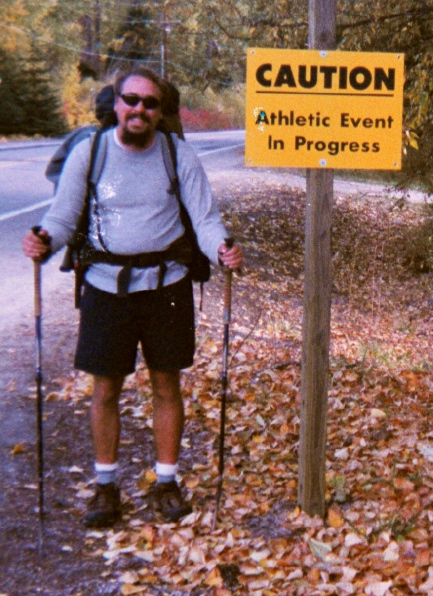
Extreme Athlete
Am I an extreme athlete? I have been jokingly asking myself that question. In Twin Lakes Resort a man walked up to me and said "I'm an extreme athlete too." Now I thought that was pretty funy, but I needed a ride. I remember a couple of days later argueing with Eagle whether or not we were indeed extreme athletes. It was pretty houmorous if I recall correctly. A couple of chuby kids dreaming about ESPN's Extreme Games.

Here is my arguement that I am an extreme athlete. I participate in the sport of backpacking or hiking. Todays top two headlines.

No charges in wilderness survival-school death
California hiker mauled by mountain lion leaves hospital

How
many sports have their participants Mauled by Lions? It is not even hiking season and we have death and a lion attack. I walk through places like this. I know some one that was attacked by a bear, was only a few miles away when it happened. Rattlesnakes, deserts, glaciers, snow covered passes, cliffs, fording rivers, lions, bears, scorpions, ticks, snow, sleet, rain, fog, hail, spiders, giardia, high altitude pulmenary edema, are some of the things that you have to deal with on a Pacific Crest Trail thru hike. Some pretty extreme stuff.